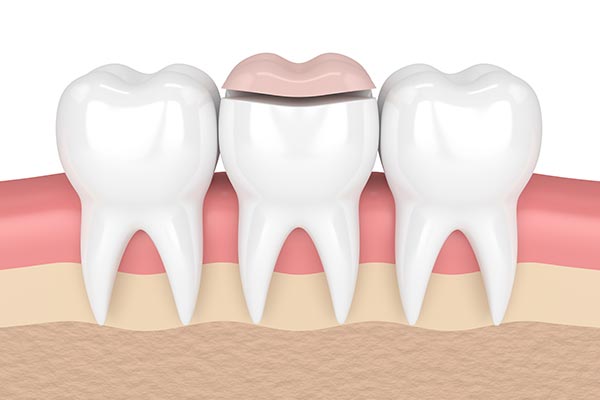
The similarities and differences between inlays, onlays, and crowns
Inlays and onlays achieve many of the same results as crowns, to the extent that they are sometimes referred to as partial crowns. All these types of tooth restoration strengthen damaged teeth and look natural, but inlays and onlays differ from crowns in a few key ways.
Restoration method
Crowns cover the entire tooth to the gum line and can be used to cap teeth that have suffered extreme damage or even as replacements for missing teeth. Inlays and onlays are placed, respectively, in or on the existing tooth. Patients can be recommended these treatments as an alternative to crowns if the tooth structure is still intact. Both procedures restore full functionality and appearance to a patient's tooth, but the crown covers the tooth entirely whereas inlays and onlays work with the existing tooth structure.
Materials
Inlays and onlays can be made of a variety of materials, including gold, ceramic, porcelain, or resin, the same as crowns. In the past, gold crowns and inlays were more common, but nowadays most patients opt for porcelain, resin, or ceramic. These materials can be colored to look indistinguishable from a patient's natural teeth. They are also very durable, lasting for years at a time, and require no more maintenance than regular teeth.
Preparation
Inlays, onlays and crowns all require a thorough examination and cleaning of the patient's teeth. This involves the removal of decay as well as any weak part of the tooth. Crowns have specific requirements in this regard because they have a minimum thickness. After this step the cosmetic dentist will have a good idea of the state of the tooth and will move on to taking impressions. A bite registration is also recorded so the dentist can know how the patient's teeth are aligned.
Procedure
The procedure for inlays, onlays, and crowns is very similar. Many cosmetic dentists have a milling machine in the office that can mill all three pieces. This allows for single-visit restorations. At an appointment, pictures are taken for the CAD/CAM milling machine. Then the piece is milled on site quickly enough for the cosmetic dentist to bond it before the patient leaves.
If an office does not have a milling machine, the patient can make two visits. During the first, pictures are taken, and a second appointment is scheduled after the new inlay, onlay, or crown arrives from the lab. In this case the patient is fitted with a temporary crown in between visits.
Conclusion
Inlays and onlays can be used as a viable alternative to crowns if a patient has a salvageable tooth structure. Patients should consult with a cosmetic dentist to find the solution that is most desirable and suitable for them.
Request an appointment or call Anthony DeLucia D.D.S., P.A. at 772-492-7045 for an appointment in our Stuart office.
Related Posts
A cosmetic dentist specializes in enhancing the appearance of the teeth, gums, and smile through various aesthetic treatments. While a general dentist focuses on overall oral health, there is a distinct difference between the two types of dental professionals in terms of their areas of expertise and the treatments they provide. Understanding the roles of…
A confident smile begins with healthy, aesthetically pleasing teeth. For those experiencing issues such as gaps, chips, or uneven teeth, a cosmetic dentist can provide solutions to restore both appearance and function. Cosmetic dentistry offers a variety of minimally invasive procedures to correct aesthetic concerns and improve your overall oral health.Gaps between teeth, also known…
A cosmetic dentist offers a range of specialized services, including professional teeth whitening. Teeth whitening by an experienced dental professional often exceeds the effects of over-the-counter products. If you are currently seeking to enhance your smile, it is essential to understand the distinction between professional treatments and over-the-counter options. While each method has its advantages…